Olivier Levasseur - Pirate Treasure on Mahé Island
Olivier Levasseur (Calais, 1680 or 1690 - Réunion, 7 July 1730), was a pirate, nicknamed La Buse or La Bouche (The Buzzard) in his early days, called thus because of the speed with which he threw himself on his enemies.
His name first appears in 1716, when he joined the Benjamin Hornigold pirate company. Olivier was a good climber, and had a scar across one eye, limiting his view.
After a year of successful looting, the Hornigold party split, with Olivier deciding to try his luck on the West African coast. In 1719 he operated together with Howell Davis and Thomas Cocklyn for a period. In 1720, he was shipwrecked in the Red Sea and stranded at the island Mayotte, one of the Comores. His eye was completely mutilated by now, and he decided to wear an eye patch.
From 1721 onwards he committed his raids from his base on the island of Saint Mary's, off the Madagascar coast. His biggest success was the conquering of the Portuguese vessel Nossa Senhora do Cabo (The Virgin of the Cape), which was full of gold. This was in cooperation with the English pirate John Taylor. He was eventually captured and hanged on the island of Bourbon (today Réunion), on 7 July 1730) 17h00, for his crimes of piracy.
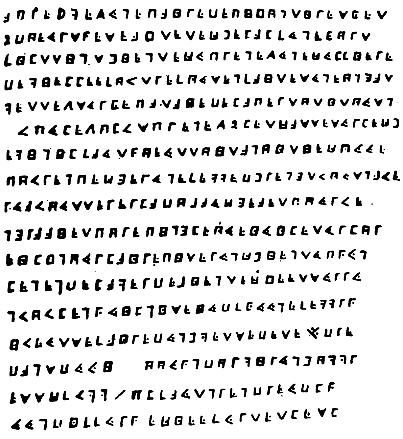
The legend tells that when he stood on the scaffold, he had a necklace around his neck, containing a cryptogram of 12 lines, and would have thrown this in the crowd while exclaiming: 'Find my treasure, he who may understand it!'
What became of this necklace is unknown. To this day, a good number of impassioned and treasure hunters have searched to find his fabulous treasure, estimated by some at a few million euros, others give it a value as much as 100 million UK pounds (2005).
In 1923 a certain Mrs. Savoy found some documents, describing Levasseur's treasure on a southern island of the Seychelles group. In one document there are some coordinates, and text in a mysterious alphabet.
At the Bel Ombre beach on the island of Mahé, stones were found, with carvings like: dogs, snakes, tortoises, horses, a ballot box, a figure of a young woman, and the head of a man.
After some excavations they discovered two coffins containing the remains of two people, identified as pirates by the gold ring in their left ear. But no treasure was found at this location.
The cryptogram was much more difficult to solve than she had believed.
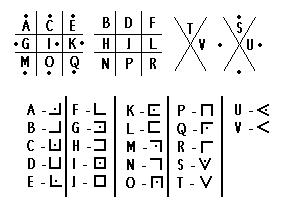
Above: The Alphabet Olivier Levasseur used in the cryptogram
Deciphering it could be carried out only by starting from the Clavicles of Solomon, two letters, a will and documents compiled in rebus or at least in initiatory writing which could be put in relation to Masonic symbolism. These documents explicitly affirmed the existence of a treasure localised on an island in the Indian Ocean. However the name of this island was not mentioned anywhere.
In 1947 Englishman Reginald Cruise-Wilkins, a friend of Mrs. Savoy, studied the problem and discovered a connection with the twelve operations of Hercules. Various tasks, representing the Labours of Hercules, had to be undertaken in strict order. The treasure chamber is somewhere underground and must be approached carefully, to avoid being inundated. It is protected by the tides, which require damming to hold them back, and is to be approached from the north. Access is through a stairwell cut into the rocks, and tunnels leading under the beach. Until 1970 he sought and dug in the island of Mahé. In a cave, except for old guns, some coins, and pirate sarcophagi, he did not find anything.
He died in 1977 before he broke the last piece of code.
The story of Levasseur's treasure was featured in the comic book series Spike and Suzy (also known in the UK as Bob & Bobette or the original names 'Suske en Wiske' by the Flemish author Willy Vandersteen), in the album The Amazing Coconut (1990). There the medallion of Levasseur was taken by a bird, which fled into the forest, where it became trapped in a mature fruit called Coco de mer. This Coco was sold in Belgium in 1988 to the heroes of the series, and they went on to discover the medallion and finally the treasure.
External Links
- Treasure Quest - Smithsonian magazine, December 2004